Our team spent the better part of two years sleeping (or trying to sleep) next to bassinets — rocking ones, mesh-walled ones, four-in-one convertible ones, and one with a mosquito net we never actually needed. Here’s what we’d buy with our own money in 2026, and why.
What actually matters in a bassinet
- Australian safety standard. Look for AS/NZS 8005 compliance on bassinets, AS/NZS 2172 for cots. Don’t compromise on this — the standard exists because babies have died in non-compliant sleeping products.
- Breathable sides. Mesh on at least two sides reduces re-breathing risk and lets you actually see the baby at 2 a.m. without lifting them.
- A firm, flat mattress. No padding, no inserts, no positioners. The mattress should be firm enough that pressing it leaves no impression and should fit the bassinet base with no more than 2 cm gap on any side.
- Wheel locks that actually lock. If the bassinet rolls, you want both braked wheels — ideally with one giant pedal across both rear wheels rather than two fiddly individual locks.
- Sensible bedside-mode latching. Co-sleeper bassinets are great, but only if the side-down latching is solid. A wobbly side-down catch is a no.
Best premium pick: Maxi-Cosi Iora Bedside Bassinet
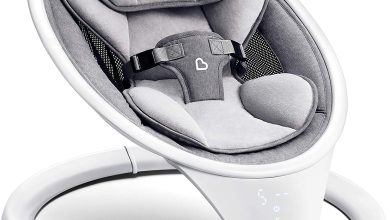
The Iora is the bassinet we kept recommending to friends through 2024 and 2025 and it still earns the spot. Eleven height adjustments (so it lines up with almost any adult bed), a tilt function for reflux-prone newborns, and breathable mesh on both long sides. It’s not cheap, but it’s the one Sarah’s still using as a portable day-nap bassinet a year past her newborn phase.
See the Maxi-Cosi Iora on Baby Domain →
Best convertible: BABY JOY 4-in-1 with Mattress
If you’d rather buy one piece of baby furniture and have it grow with your child, the BABY JOY 4-in-1 takes you from bassinet to bedside sleeper to playpen to changing station. It’s heavier than the Iora and the wheels aren’t as nice, but the value-per-dollar is the highest in this list.
See the BABY JOY 4-in-1 on Baby Domain →
Best portable: Cloud Bedside Baby Bassinet
If you do a lot of weekend visits to family or you live across two homes, the Cloud is the one we’d take. It folds flat, it’s light enough to one-arm into the boot of a hatchback, and the mosquito net is genuinely useful for outdoor naps in summer. The mattress is fine but not great — we’d budget another $40 for a firmer aftermarket mattress that fits the same dimensions.
See the Cloud bassinet on Baby Domain →
The one we’d skip
We don’t recommend any bassinet that ships with built-in padded bumpers, padded inserts, or branded sleep positioners — even ones marketed as "safe". Red Nose Australia advise against all of these, and we’ve seen far too many products on AU marketplaces still bundling them as a feature.
Bassinet vs. cot vs. co-sleeper: a quick decision tree
- Newborn to ~4 months in your bedroom? Bassinet or bedside co-sleeper.
- Newborn straight into the nursery? Cot from day one is fine and saves you a step.
- Apartment or single-room living? Convertible 4-in-1 saves floor space.
- Twins? Don’t put two babies in one bassinet. Two separate bedside cribs or two cots, every time.
How long will baby actually use a bassinet?
Most of the bassinets we tested were comfortable until baby hit the manufacturer’s weight limit (usually 9 kg) or started rolling and pushing themselves up — whichever came first. For most Australian babies that’s somewhere between 4 and 6 months. After that you’re moving them to a cot, full stop.
Baby Domain is a participant in the Amazon Services LLC Associates Program. When you buy through links on our site we may earn a small commission at no extra cost to you. We only recommend products we’d buy ourselves.